
More than half of the businesses on Pathways off the Plateau expect to increase their annual turnover as a direct result of the programme. Two thirds anticipate improved efficiency. For the pilot cohort, this is a promising sign – not just of individual progress, but of wider potential for the region’s tech economy.
Over the past few months, 15 South Yorkshire tech businesses have taken part in the programme – a pilot funded by the Department for Science, Innovation and Technology – designed specifically to support established companies that, while successful, still have the potential to grow much further. The structured delivery has now come to an end, and each business has a tailored action plan for growth.
Now, the focus is on implementation, meeting that potential, and more. We’ve heard from programme participants as well as Project Manger, Chris Dymond, about early signs of impact, key learnings and the unexpected consequences of this pilot project.
Creating space to think differently
One of the clearest themes to emerge from participants was the value of stepping back. Running a business often means operating at pace, with little time to properly reflect on strategy, processes and opportunities. Creating that space proved to be one of the most impactful elements of the programme.
“Pathways off the Plateau helped me take a step back from the business,” says Ian Pickles, CEO and co-founder of imoves. “It’s given me tools to really think through my strategy and plan out our next steps.”
For others, it was about sharpening their approach to a specific area of the business:
“An excellent programme which made us step back and fine tune our approach to sales from the perspective of our key client groups,” explains Richard Moore, CTO of LOHA.
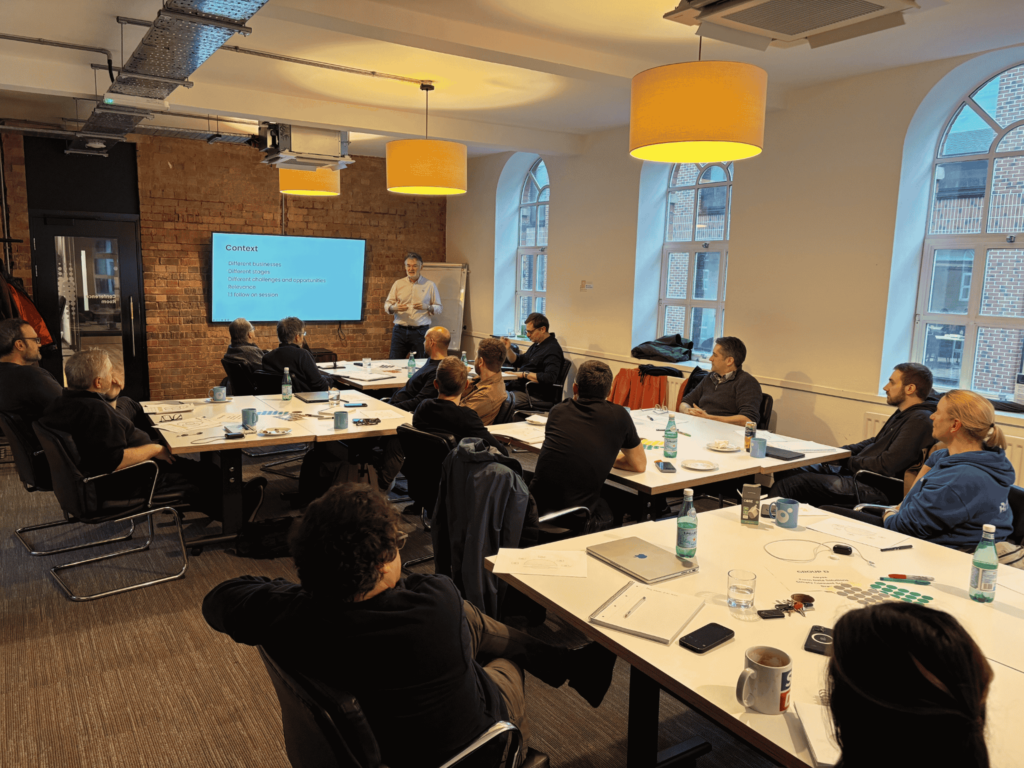
For Chris Dymond, Project Manager, it was about taking a fresh approach to areas of the business that was holding them back. “A lot of founders, especially technical ones, don’t naturally think in terms of systems across areas like sales, marketing or financial forecasting,” he explains. “We wanted to help make those things more systematic. Once founders start to see these areas as systems – based on data, sequences and optimisation – it becomes much easier to improve them.”
Alongside this, the programme also helped to unlock something less tangible but equally important: ambition and motivation. As Chris reflects, “Part of the challenge for companies on the plateau isn’t just systems, it’s drive. We wanted founders to gain energy from working alongside others, to feel that sense of momentum again.”
Practical support for established businesses
Whilst high-quality early-stage startup support is widely available in South Yorkshire, fewer programmes focus on the realities of scaling; refining systems, identifying barriers, improving sales processes, and building sustainable growth.
This gap was a key driver behind the programme’s creation. “There’s a lot of support for startups and spinouts,” says Chris, “but almost nothing for established tech businesses. Yet most people working in tech are in these kinds of companies. That’s the core of the ecosystem.”
Unlike more general business support, Pathways off the Plateau focused specifically on the needs of technology-led businesses, where questions around scalability, maintainability, and business models require a specialist understanding.
As one participant put it, “There is not a lot of support available for established tech businesses, so it’s been great having open and honest conversations with others in the same boat and helping each other out. Some future joint working opportunities identified, too.”
For some, the support came at a critical time.
“Pathways on The Plateau has offered vital direction and inspiration for the future of my company – a future that felt highly uncertain in December 2025,” says Kimb Jones, CEO of Make Do (MKDO Ltd). He adds, “This initiative has been instrumental, allowing me to reflect, learn, and develop a clear strategy to improve and grow the business out of its current situation.”
The programme’s emphasis on practical application stood out:
“We took really good active points from every exercise rather than just talking – which is what we needed,” says Jilly Cross, founder and CEO of Bravand.
Learning from others in the same position
Peer support – offered through curated accountability circles – was another defining feature.
Bringing together founders facing similar challenges, which were identified following their initial diagnostic sessions, created space for honest conversations and shared problem-solving, something many participants said they don’t often get elsewhere.
Tony Buck, Director of EyeSiteView, explains, “It’s honest, practical, and being around other founders in the same boat has been a big part of the value.”
The cohort itself also reflected a broader and more diverse cross-section of the region’s tech economy than initially expected. “We ended up working with companies we didn’t even know existed,” Chris explains. “Many weren’t connected to the tech ecosystem at all – they’d grown out of specific industries and built technology to solve problems in those niches.”
For some, the programme provided a first meaningful connection into that ecosystem. One participant reflects,
“I have re-discovered my passion for getting to meet new people, discuss the merits of what I’m trying to achieve and how to get to market with my new company and products.”
Chris highlights that this sense of connection was one of the most important outcomes: “A lot of these companies are quite isolated – even internally many people work remotely, sometimes not even geographically close to each other. Integrating them with each other and with the wider ecosystem was a really big part of the programme.”
Turning insight into action
The programme was designed to move beyond ideas and learning, into implementation.
Each business has developed a bespoke action plan, and while outcomes will take time to fully materialise, early indicators taken from participant feedback are promising:
- 65% expect increased efficiency
- 57% expect increased turnover
- 57% expect increased visibility
Additionally, just over a quarter of participants expect to introduce new innovation into their business, and another quarter anticipate team growth.
These expectations reflect practical changes already underway. From refined internal systems to more structured approaches to sales, the programme has identified tangible ways to unlock business growth.
“We’re not short on demand or ideas,” says Tony (EyeSiteView), “we needed tighter systems and a more repeatable route to recurring revenue.”
Extending the reach: sharing key learnings
Alongside the core programme, a public webinar extended insights that emerged during delivery to a wider audience.
The session focused on the realities of building AI-powered applications that are secure and scalable – an issue that surfaced organically through the cohort. As the programme progressed, it became clear that the rise of “vibe coding” and AI-assisted development was a particularly complex and, at times, misunderstood challenge for some businesses.
“It wasn’t something that was relevant to every company on the programme,” explains Chris, “but it was a really important and quite thorny issue for some, and we sensed for businesses beyond the cohort as well.”
Rather than confining that learning to the programme, the team chose to open up the conversation.
The result was a highly engaged public webinar, bringing together local experts to explore both the opportunities and risks of AI-assisted development. With over 40 attendees, the level of interest highlighted just how timely the topic is.
“It was an absolutely terrific discussion,” Chris reflects. “Most conversations about AI focus on what’s possible. What we wanted to do was focus on the realities; what these tools mean for business owners, how to use them, and just as importantly, how not to use them.”
The session deliberately avoided technical jargon, instead translating complex ideas into practical insights for business leaders. It explored key considerations such as ownership, scalability, security, and long-term maintainability – areas that can easily be overlooked when rapidly building AI-enabled products, especially by non-technical professionals.
For participants, this grounded, experience-led approach stood out.
“The Pathways off the Plateau webinar came at exactly the right moment… Most conversations about AI-assisted development right now focus on the possibilities; this one focused on the realities,” reflects James Howard from YellowNest, who was not a participant of the full programme, but was attracted to the specialist nature of the webinar. He added: “It gave us a clearer, more honest basis for the decisions we need to make.”
That practical framing also resonated with Alex Kelly, who organises the Steel City AI Meetup, where people learn how to use AI to develop new applications each month. Alex took part in the webinar as a panellist, describing the session as: “A well-organised and engaging session that brought together real world perspectives on AI, making complex topics accessible and relevant for both technical and business audiences.”
By opening up one of the programme’s most complex emerging themes, the webinar demonstrated how Pathways off the Plateau can generate value beyond its core cohort – sharing timely, experience-driven insight with the wider ecosystem.
What comes next
With delivery of Pathways off the Plateau complete, attention now turns to implementation, but also to what comes next for the programme itself.
For Chris, the case for continuing is clear. “There’s definitely a gap for this kind of support,” he says. “Most people working in tech are in established businesses that aren’t startups and aren’t attracting investment. That’s the core of the ecosystem – and it’s largely underserved.”
There is potential for the programme to evolve into a regular intervention, building on what has been learned through this pilot. A key part of that is understanding what delivered the most value.
One of the most significant outputs is the diagnostic tool itself, a structured process combining in-depth interviews with a maturity model to generate tailored insights and recommendations. “Even businesses that didn’t join the full programme benefited from that,” Chris explains. “It’s something we could offer independently in future.”
At the same time, the pilot has highlighted areas where further support is needed. One of the most prominent gaps is in business intelligence; how companies gather, analyse and act on their data.
“Many businesses are collecting data but not really using it,” Chris notes. “With better data and better visibility, some of the challenges they face could be predicted or avoided altogether.”
There are also broader shifts underway that will shape future support needs. The definition of a ‘tech company’ is evolving, with more businesses from sectors like professional services and education developing their own digital products.
“We’re seeing companies effectively turning into tech businesses,” Chris says. “We need to think about how we support and integrate them into the ecosystem.”
As these changes accelerate, the need for targeted, practical support for established businesses is only likely to grow. It will be fascinating to follow the 15 companies who have taken part, each moving forward with clearer priorities, stronger systems, and renewed momentum. We’ll follow up with each in 12 months, to gauge the longer term impact of the programme.
As Gavin Kimpton, Director at Pipe Ten Hosting, sums up:
“A timely injection of direction, energy, and confidence that’s empowered me to take my business to the next level.”Led by Sheffield Digital, Pathways off the Plateau is part of the Regional Tech Booster programme and funded by the Department for Science, Innovation and Technology, in partnership with the UK Tech Cluster Group. You can find out more about this initiative, here: https://www.techclusters.uk/regional-tech-booster/.