
Long-standing Sheffield Digital member, Nimble Approach has undergone an exciting evolution since we last spotlighted the company back in 2020, overseen by the new CEO, Matt Carroll. This phase of growth has included increased investment in Data and AI and the launch of new specialist capabilities. We spoke with Matt about his career journey, how the business is evolving, Sheffield’s strengths as a technology city, and why he believes the combination of data, AI and human expertise will define the next generation of successful organisations.
Tell us about your journey to becoming CEO at Nimble.
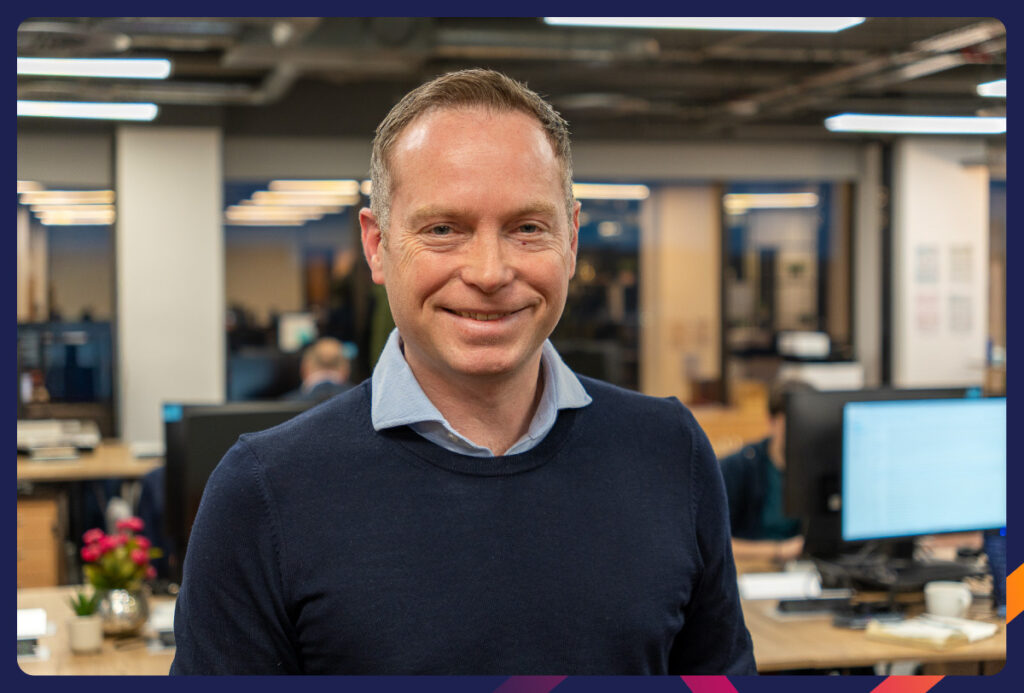
My career has always sat at the intersection of technology, transformation and people. I spent more than a decade at Accenture, leading complex technology programmes, helping organisations navigate large-scale change and latterly growing technology platform businesses. Throughout that time, I became increasingly passionate about how technology can create meaningful outcomes when it is designed around people and business needs rather than technology for technology’s sake.
When the opportunity arose to join Nimble, it felt like a natural fit. Nimble had already built a strong reputation for delivery excellence, deep engineering expertise and a culture centred on its people. What excited me most was the opportunity to help shape the next phase of growth – building on those foundations and expanding into areas that will define the future of our industry – particularly Data and AI.
It’s been a while since we checked in with the team at Nimble in Sheffield, can you paint a picture of what life at your Sheffield HQ is like now?
Sheffield has been home to Nimble since the beginning, and it’s where much of our culture has been built. Today, more than 20 people work from our Sheffield office across Engineering, Data, Product, Finance, IT and People, creating an environment where collaboration happens naturally across teams. As we’ve grown, we’ve worked hard to keep the feel of a close-knit business, where people know each other, share ideas, and have the opportunity to make a real impact.
That sense of community extends beyond our own teams too. We regularly open our doors to the local tech community by hosting events such as Ministry of Testing Sheffield, where our colleagues have shared practical insights on AI in testing, and we’re proud to support charitable initiatives through Nimble Gives Back. Alongside regular team socials, these moments help bring people together, strengthen relationships, and make Sheffield a great place to build both your career and your professional network. Whether you’re building products, solving complex data challenges or supporting the wider business, you’ll find a culture built on collaboration, curiosity, and making a meaningful contribution.
How has the business evolved during your time here?
Nimble has always been known for delivering high-quality digital and engineering outcomes. We’re now investing in and accelerating the growth of our Data and AI capabilities.
A key part of that evolution has been the launch of Think Nimble AI, our specialist practice focused on building intelligent, agentic AI systems that can reason, plan and execute across complex business workflows. Rather than applying AI for AI’s sake, we focus on solving high-friction operational challenges and helping organisations realise measurable business value, while maintaining strong governance and human oversight.
At the same time, we’ve expanded our Data practice through our partnership with Databricks. This strengthens our ability to help organisations modernise their data platforms, unify and govern siloed data sources and build the trusted foundations needed for advanced analytics, automation and AI-driven use cases.
By combining deep expertise in Product, Design, Engineering, Data and AI, we’re helping clients build future-ready capabilities that support innovation and sustainable growth.
What opportunities do you see in the market today?
Many organisations are under pressure to become more efficient, make better decisions and deliver better customer experiences. At the same time, technology is advancing at an unprecedented pace.
The biggest opportunity lies in helping organisations bridge the gap between ambition and execution. Many businesses understand the potential of AI, automation and modern data platforms, but turning that potential into measurable business value is often challenging.
We also see significant opportunities in cyber intelligence, where security teams are often overwhelmed by the volume and complexity of threat data. AI can help organisations identify genuine threats faster, reduce false positives and provide analysts with clear, actionable insights, enabling more effective and proactive cyber defence.
Organisations don’t need more hype; they need partners who can help them navigate complexity, modernise their technology estates, improve data maturity and deliver tangible outcomes.
Why have Data and AI become strategic growth areas for the business?
Quite simply, data is becoming one of the most valuable assets an organisation possesses.
The conversation has evolved beyond reporting and analytics. Organisations now want to automate decision-making, create intelligent products and services, improve operational efficiency and unlock new revenue opportunities through AI.
However, AI is only as effective as the data that powers it. That’s why we’ve invested heavily in growing our Data and AI capabilities, including our focus on Databricks. We see a huge opportunity to help organisations build trusted, governed, scalable data foundations that enable AI to deliver real business value.
For us, Data and AI are not standalone capabilities. They complement our existing strengths in Product, Design and Engineering, allowing us to deliver end-to-end outcomes – not just the data and technology.
What misconceptions do organisations commonly have about AI?
One of the biggest misconceptions is that AI is primarily a technology challenge.
In reality, successful AI adoption is often more about people, processes, governance and data than it is about the models themselves.
Another common misconception is that AI can somehow compensate for poor-quality data. Organisations often rush to experiment with AI before addressing underlying data issues, only to discover that the outputs are inconsistent or unreliable.
Finally, there is a tendency to overestimate what AI can achieve in the short term and underestimate its long-term impact. The organisations seeing the greatest success are taking a pragmatic approach: focusing on specific business problems, building strong foundations and scaling from proven use cases.
Why is data maturity such an important foundation for successful AI initiatives?
Data maturity is the difference between AI being an interesting experiment or becoming a strategic capability.
If data is fragmented, poorly governed, difficult to access, or lacking trust, AI will amplify those problems rather than solve them. Conversely, organisations with mature data capabilities can move much faster because they have confidence in the information underpinning decisions and automated processes.
Strong data maturity means having clear ownership, governance, quality standards and platforms that enable data to be used effectively across the organisation. It creates the foundation upon which AI can be deployed safely, responsibly and at scale.
What does responsible and effective AI adoption look like in practice?
Responsible AI starts with recognising that AI should augment human capability rather than replace human judgement.
Effective adoption means establishing clear governance, ensuring transparency around how decisions are made, maintaining appropriate levels of human oversight and continually monitoring outcomes.
It also means being deliberate about where AI is applied. The most successful organisations are not trying to apply AI everywhere at once. Instead, they focus on areas where it can create meaningful value, manage risk appropriately and improve experiences for customers and employees.
Ultimately, responsible AI is about balancing innovation with accountability.
What strengths do you think Sheffield has as a technology city?
Sheffield (and the wider North) has a fantastic combination of technical talent, academic excellence, entrepreneurial spirit and a strong sense of community.
The city benefits from world-class universities, a growing technology ecosystem and a collaborative culture that encourages innovation. It also offers a compelling alternative to some of the larger technology hubs, combining access to talent with a strong quality of life.
Importantly, Sheffield has a long history of reinvention. That resilience and willingness to adapt are qualities that continue to drive the city’s technology sector forward.
What skills and capabilities will organisations need more of over the next five years?
Technical skills will remain important, but I believe the biggest differentiator will be the ability to combine technical expertise with business understanding and human-centred thinking.
Data & AI literacy will become increasingly important across all functions, not just within technology teams. Organisations will also need people who can work effectively across disciplines, connecting business strategy, user needs, technology and data.
Alongside this, skills such as critical thinking, adaptability, problem-solving and ethical decision-making will become even more valuable as AI becomes embedded within everyday operations.
What excites you most about the future of the business and the industry?
What excites me most is that we’re still at the beginning of a major transformation.
The combination of cloud, data, AI and modern engineering practices is creating opportunities that simply didn’t exist a few years ago. Organisations have the potential to become more intelligent, more efficient and more responsive than ever before.
For Nimble, the opportunity is particularly exciting because we bring together Product, Design, Engineering, Data and AI expertise under one roof. That allows us to help clients move beyond isolated technology projects and deliver genuinely transformational outcomes.
Most importantly, I believe technology works best when it empowers people. The future isn’t about replacing human potential; it’s about unlocking it. That’s what excites me most, both for our business and for the industry as a whole.
Find out more about how Nimble Approach is helping organisations build modern data and AI capabilities: https://nimbleapproach.com/ and see regular updates from the team on LinkedIn.